


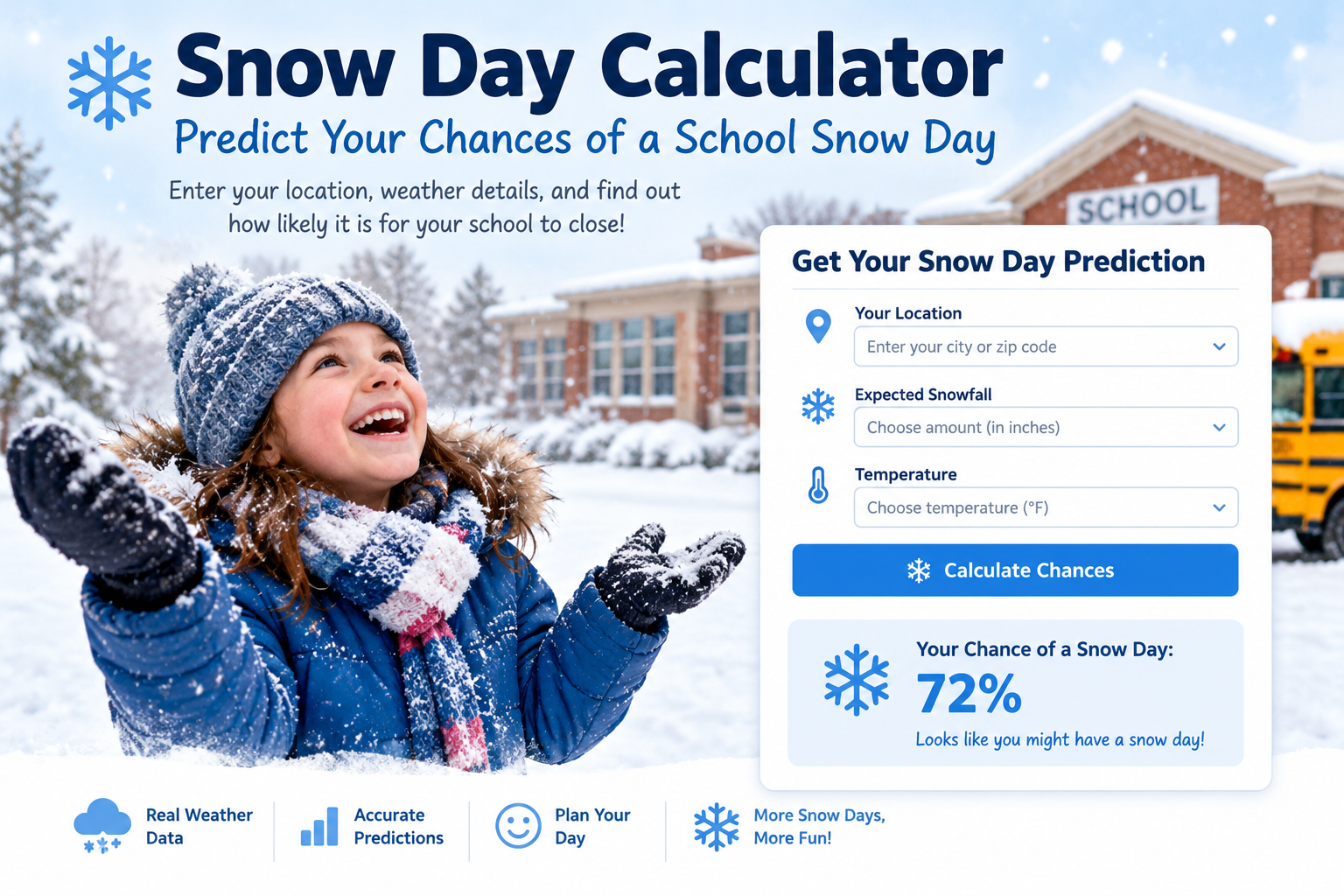
Winter weather can make school mornings exciting and stressful. Students hope for a day off, while parents and teachers want to know what to expect. A snow day calculator can help you estimate the chances of a school closure based on local weather conditions.
This helpful tool looks at factors like snowfall, temperature, ice, wind, and the timing of a winter storm. Some calculators also consider school schedules and regional weather patterns. The results give you a quick idea of whether classes might be canceled.
However, no online tool can guarantee a snow day. Every school district has its own safety rules and closure process. Weather conditions can also change quickly.
In this guide, you will learn how these calculators work, which weather factors matter most, and how to understand their results. You will also discover useful tips for checking school closure updates and planning ahead.
What Is a Snow Day Calculator?
A snow day calculator is an online tool that estimates the possibility of school closures during winter weather. It uses weather information and other details to predict whether students might get a day off.
Most tools ask for details such as your location, expected snowfall, and current temperature. Some use local weather forecasts automatically. Others allow users to enter information manually.
After reviewing these details, the calculator produces an estimated probability. For example, it might suggest a 70% chance of a snow day. This means conditions appear favorable for a closure, but the school may still open.
These tools are especially popular among students during winter storms. Parents can also use them to prepare for possible schedule changes. Teachers may find them useful when planning lessons around uncertain weather.
Remember that a prediction is not an official announcement. Always check your school’s communication channels before changing your plans.
How Does a Snow Day Calculator Work?
A snow day prediction tool combines weather conditions with information about local travel risks. Its exact method depends on the website or application you use.
Some calculators use forecast data from weather services. Others rely on information entered by the user. Advanced tools may consider historical weather patterns and previous school closure decisions.
For example, imagine your area expects eight inches of snow overnight. Temperatures remain below freezing, and strong winds reduce visibility. A calculator may estimate a high chance of school closure.
Now imagine another area receives only one inch of snow. Roads remain clear, and temperatures stay above freezing. The same tool may estimate a much lower chance.
The important point is that snowfall alone does not determine the outcome. Road conditions, storm timing, and local safety policies can make a major difference.
A good calculator provides a helpful estimate rather than a promise. Its accuracy depends on the quality of its weather data and prediction method.
Why Is a Snow Day Calculator Useful?
Winter storms can disrupt normal school routines. Families may need to arrange childcare, change travel plans, or prepare for remote learning. A calculator can help them think ahead.
Students often use these tools to satisfy their curiosity before a snowy school morning. They can enter local conditions and see how different weather factors affect the prediction.
Parents can use the estimate to prepare backup plans. For example, they might arrange childcare if a closure seems possible. Teachers can also prepare alternative lessons if weather conditions worsen.
A snow day calculator is useful because it turns several weather details into one simple estimate. Users do not need advanced weather knowledge to understand the basic result.
Still, the tool should support your planning rather than replace reliable information. Check weather alerts and official school messages before making important decisions.
Key Factors That Affect Snow Day Predictions
Several conditions can influence whether a school closes during winter weather. A calculator may consider some or all of the following factors.
1. Amount of Snowfall
Heavy snowfall can cover roads, sidewalks, parking areas, and school entrances. Large snow accumulations may make travel unsafe for students and staff.
However, even light snowfall can cause problems in places without regular winter weather equipment.
2. Temperature
Low temperatures can freeze wet roads and create dangerous driving conditions. They may also increase the risk of icy sidewalks and frozen surfaces.
3. Ice and Freezing Rain
Ice can make roads slippery, even when snowfall is limited. Freezing rain is particularly dangerous because it creates a thin layer of ice on exposed surfaces.
4. Wind and Visibility
Strong winds can blow snow across roads and reduce visibility. Severe conditions may make school buses and other vehicles harder to operate safely.
5. Storm Timing
Snow arriving overnight can affect morning travel. A storm that begins after school starts may create different safety concerns.
6. Local Road Conditions
Main roads may be clear while smaller streets remain covered in snow. School transportation routes can therefore influence closure decisions.
A useful snow day calculator considers several of these factors together. No single measurement tells the whole story.
How to Use a Snow Day Calculator
Using an online prediction tool is usually simple. You only need a few details about your location and expected weather.
Follow these steps:
- Open a snow day prediction website.
- Enter your city, ZIP code, or school location if requested.
- Review the expected snowfall for your area.
- Add temperature and other weather details when needed.
- Submit the information to generate an estimate.
- Read the predicted probability carefully.
- Check the latest forecast for possible changes.
Some websites automatically collect weather information based on your location. Others need you to provide the details yourself.
For the best estimate, use a recent forecast rather than an outdated weather report. Conditions may change several hours before your school day begins.
If the calculator shows a high probability, prepare for a possible closure. However, continue checking official school updates until a decision is announced.
Understanding Snow Day Probability
Many prediction tools display their results as percentages. These numbers help users understand how likely a closure may be, but they require careful interpretation.
For example, a result of 80% suggests a high estimated chance of a snow day. It does not mean the school must close. The school district may have better road information or different safety requirements.
Likewise, a 20% result suggests a lower estimated chance. A sudden storm or unexpected ice could still lead to a closure.
Here is a simple guide to understanding probability results:
| Estimated Probability | General Meaning |
| 0%–20% | Low estimated chance |
| 21%–40% | Some possibility |
| 41%–60% | Uncertain outcome |
| 61%–80% | High estimated chance |
| 81%–100% | Very high estimated chance |
These ranges are general examples, not official forecasting standards. Different calculators may use different methods.
Always remember that probability describes uncertainty. It cannot replace a confirmed school announcement.
How Accurate Is a Snow Day Calculator?
The accuracy of a snow day prediction depends on several things. These include the weather data, the prediction method, and how well the tool understands local conditions.
A calculator using current forecasts may provide a useful estimate. However, some websites rely on simple formulas or limited information. Their results may not reflect changing road conditions or local school policies.
For example, a town expecting six inches of snow might close schools because buses cannot travel safely. Another town receiving the same amount might remain open because roads are treated quickly.
This difference shows why one prediction cannot work equally well everywhere. Local experience and school transportation systems matter.
You can improve your understanding by comparing the calculator with a trusted weather forecast. Look for winter storm warnings, freezing rain alerts, and expected snowfall timing.
Use the estimate as one source of information. For the final decision, rely on your school district’s official announcement.
Best Time to Check Snow Day Predictions
Timing matters when you are trying to estimate a possible school closure. Weather forecasts often become clearer as a storm approaches.
Checking a prediction tool the night before school can help you prepare. You can review the expected snowfall and identify possible travel problems.
However, you should check again in the early morning. Overnight temperatures may drop, snow may arrive sooner than expected, or freezing rain may develop.
For example, a forecast might predict moderate snow at 8 p.m. By 5 a.m., updated information could show heavier snowfall and icy roads. That change may affect the likelihood of a closure.
A practical approach is to check the forecast in the evening and again before leaving home. Enable school alerts if your district offers them.
Do not rely on a single prediction made many hours earlier. Fresh weather information provides a better picture of current conditions.
Snow Day Calculator for Students and Parents
Students and parents often have different reasons for checking winter weather predictions. A student may want to know whether classes will be canceled. A parent may need to organize childcare or adjust a work schedule.
For students, a calculator can make weather forecasting more interesting. It can also teach basic ideas about probability, temperature, and storm conditions.
Parents can use the result to prepare for different possibilities. They might charge devices, arrange transportation, or check whether online lessons are available.
Families should also prepare for the possibility that school remains open. Keep winter clothing ready and allow extra travel time when conditions are poor.
Consider a family expecting heavy snow overnight. The calculator shows a high closure probability, so the parents arrange backup childcare. The school later announces a closure, and the family is ready.
Even if school opens, the preparation remains useful. The goal is not to guess perfectly. It is to make sensible plans before the weather becomes difficult.
Difference Between a Snow Day and a Delayed Opening
A snow day and a delayed opening are not the same thing. Understanding the difference helps families plan their mornings.
A snow day usually means regular classes are canceled for the day. Depending on the school, students may receive assignments online or complete missed work later.
A delayed opening means school begins later than usual. This gives road crews more time to clear snow and allows temperatures or visibility to improve.
For example, a school normally opening at 8 a.m. might delay classes until 10 a.m. If conditions remain unsafe, the district could cancel school instead.
Some calculators estimate the chance of a closure without predicting delays separately. Others may provide additional information about possible schedule changes.
Always read the result carefully. A high chance of a weather-related disruption does not automatically mean a full day off.
Check the exact announcement from your school. It should explain whether classes are canceled, delayed, or moved online.
Snow Day Calculator vs. Weather Forecast Apps
A weather forecast app and a snow day calculator serve related but different purposes. Both can help you understand winter weather, but they may provide different kinds of information.
Weather apps usually focus on conditions such as temperature, snowfall, wind, precipitation, and alerts. They help you understand what the weather may look like throughout the day.
A snow day calculator focuses on the possible effect of those conditions on school schedules. It may turn weather information into an estimated closure probability.
For example, a weather app might forecast five inches of snow overnight. A prediction tool may use that snowfall estimate, along with temperature and location, to estimate the chance of school closing.
Neither tool can guarantee the school’s decision. A forecast describes expected weather, while a calculator estimates a possible outcome.
For a more complete picture, use both tools together. Review the forecast, understand the risks, and check official school announcements.
Tips for Getting Better Snow Day Predictions
You can make more informed decisions by using a few simple habits. These steps will not guarantee an accurate prediction, but they can help you understand the situation.
- Enter the correct location: Weather can differ between nearby towns and neighborhoods.
- Use updated forecasts: Fresh information is more useful than an old report.
- Check snowfall timing: Snow during morning travel may create greater problems.
- Watch for ice: Freezing rain can be dangerous even with little snow.
- Consider local conditions: Hilly roads and rural routes may create extra risks.
- Compare information: Review the calculator alongside a trusted weather service.
- Follow school alerts: Official messages confirm the actual schedule.
It is also helpful to learn how your school handles winter storms. Some districts close quickly when buses cannot travel safely. Others may delay opening while crews clear roads.
Over time, you may notice patterns in local decisions. Still, every storm is different, so past closures cannot predict future results with certainty.
Common Mistakes to Avoid When Predicting a Snow Day
One common mistake is assuming that heavy snowfall always means school will close. Some districts have strong snow-clearing systems and can operate safely during substantial snowfall.
Another mistake is ignoring freezing rain. A small amount of ice may create greater travel risks than several inches of light snow.
Some people also trust a single calculator result too much. Different tools may use different weather data and prediction methods. Their percentages may therefore disagree.
Checking outdated forecasts can also lead to poor planning. Winter storms sometimes change direction, speed, or intensity within a few hours.
Finally, do not confuse a prediction with an official decision. A calculator may show a high chance of closure, but the school may remain open.
The best approach is to consider several sources of information. Use current forecasts, understand local travel risks, and check school messages. This simple routine can help you prepare without relying on guesses.
How Schools Decide Whether to Close
School closure decisions usually involve several practical concerns. Administrators consider whether students, teachers, bus drivers, and other staff can travel safely.
Road conditions are especially important. Schools may serve students from many neighborhoods, including areas with steep roads or limited snow removal.
Administrators may also review weather warnings, expected snowfall, wind chill, and the timing of a storm. Some districts consult transportation teams or local safety officials before making a decision.
The process can vary widely by region and school system. A district with regular winter storms may handle snow differently from one that rarely receives snowfall.
School leaders must also consider building access, heating systems, and whether staff can reach the campus. Even when roads improve, other problems may affect normal operations.
A snow day calculator cannot see every detail that school officials consider. It offers an estimate based on available information, while the school makes the final decision.
What to Do When a Snow Day Is Announced
A school closure can provide extra time for rest, family activities, or catching up on schoolwork. However, winter safety should remain a priority.
First, confirm the announcement through an official school website, app, email, or message. Make sure the closure applies to your school and grade level.
Next, review any instructions about online classes or assignments. Some schools use remote learning during weather disruptions, while others provide a full day off.
If you go outside, wear suitable winter clothing and avoid icy areas. Children should stay away from snow-covered roads and locations where drivers may have poor visibility.
Parents can use the time to review emergency supplies and check on family members. If travel is necessary, check local road conditions before leaving.
Most importantly, do not travel simply because a prediction tool suggested school would open. Safety should guide your decisions when conditions become dangerous.
Future of Snow Day Prediction Tools
Weather technology continues to improve how people understand storms. Modern forecasting systems can process large amounts of weather data and identify changing conditions more quickly.
Some prediction tools may combine detailed forecasts with local school information. Others may use historical patterns to estimate how certain weather conditions affect closure decisions.
Machine learning could help some tools recognize relationships between snowfall, road risks, and past school schedules. However, useful predictions still depend on accurate data and sensible methods.
Future tools may offer more location-specific estimates and clearer explanations of their results. They could also help users understand whether snow, ice, or wind contributes most to the predicted risk.
Even with better technology, uncertainty will remain. Weather can change unexpectedly, and school leaders must consider practical conditions that online systems may not capture.
The most helpful tools will explain their limits instead of promising perfect results. Users should continue treating predictions as guidance rather than official decisions.
Conclusion: Use a Snow Day Calculator Wisely
A snow day calculator is a simple way to estimate whether winter weather might interrupt your school schedule. It can help students satisfy their curiosity and allow parents to prepare for possible changes.
The most useful predictions consider several factors, including snowfall, temperature, ice, wind, and storm timing. Local road conditions and school policies also play important roles.
However, no calculator can guarantee that school will close. Forecasts can change, and school administrators may have information that an online tool does not include.
For the best results, review an updated weather forecast, use a reliable prediction tool, and follow official school announcements. Prepare for both possibilities so you are ready whether classes continue or get canceled.
Have you ever experienced a surprise snow day? Share your experience and the weather conditions that led to it. Your story may help other readers understand how unpredictable winter school schedules can be.
Frequently Asked Questions (FAQs)
1. What is a snow day calculator?
A snow day calculator is an online tool that estimates the chance of school closing because of winter weather. It may use snowfall, temperature, location, and other conditions to produce a probability. The result is only an estimate, not a confirmed school announcement.
2. How accurate is a snow day calculator?
Accuracy depends on the tool’s weather data, prediction method, and understanding of local conditions. A calculator may provide a useful estimate, but unexpected ice or changing snowfall can affect the result. Always check your school district’s official announcements.
3. Can I use a snow day calculator for my location?
Yes, if the tool supports your area. Some calculators request a city or ZIP code, while others use manually entered weather information. Check that the selected location matches your school or the roads students use.
4. What percentage means school will probably close?
A high estimated probability generally suggests a greater chance of closure. For example, an 80% estimate indicates that the tool considers a closure likely. However, percentages vary by calculator and cannot confirm the final decision.
5. When should I check a snow day calculator?
Check the prediction the evening before school and again in the morning. Updated forecasts may reveal changes in snowfall, temperature, or road conditions. Continue checking official school messages until the schedule is confirmed.
6. Does heavy snow always cause a school closure?
No, heavy snowfall does not always lead to a closure. Schools may remain open when roads are safe and snow removal works well. In other cases, light snow or freezing rain may create dangerous conditions and cause a delay or cancellation.
