


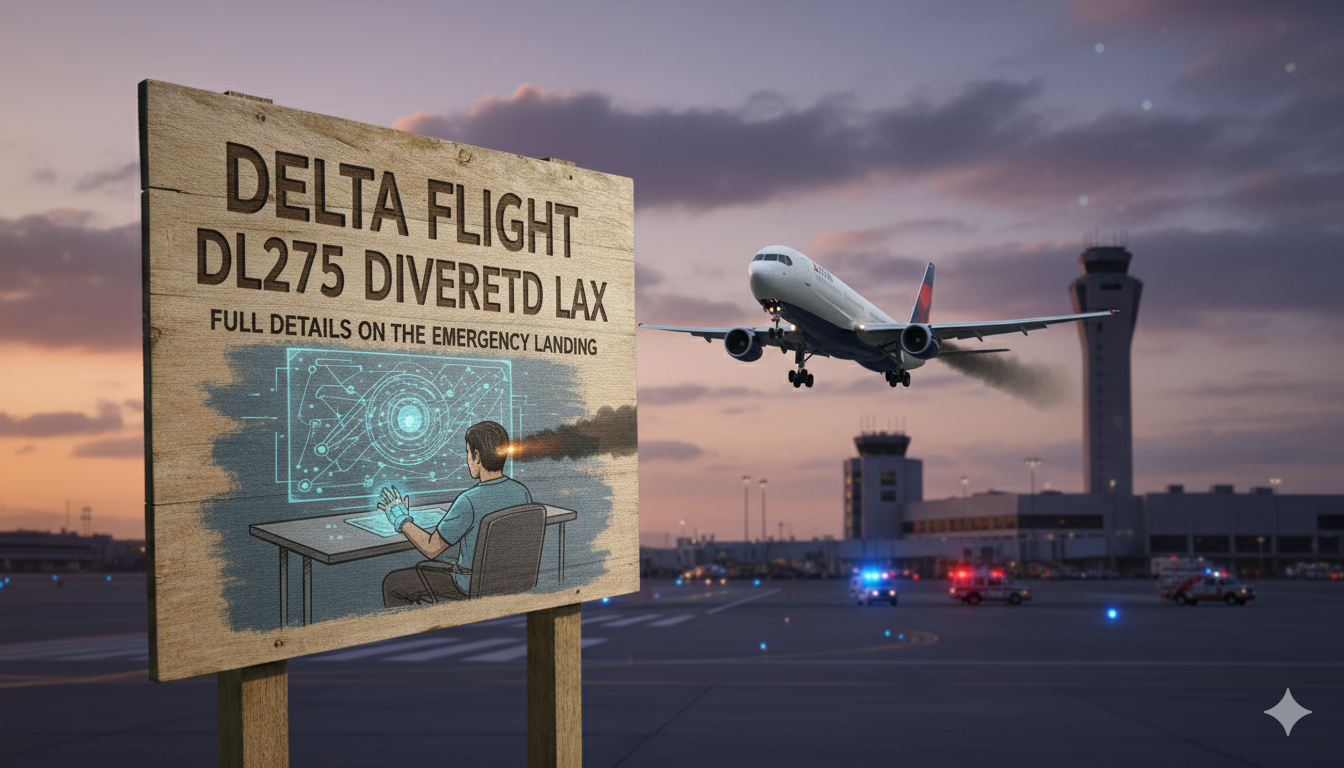
Imagine being 38,000 feet over the cold North Pacific Ocean, dreaming of the bright lights of Tokyo. Suddenly, the pilot announces a change of plans. This is exactly what happened when Delta flight DL275 diverted LAX during a long trip from Detroit to Tokyo Haneda. While flying near the Bering Sea, the crew noticed a technical glitch that changed everything. Instead of landing in Japan, the massive Airbus A350-900 turned around and headed for California.
It is never fun to have your travel plans ruined, but safety always comes first in the sky. For the hundreds of people on board, this meant a very long day of flying. In fact, by the time they landed in Los Angeles, they had been in the air for over 12 hours. That is almost as long as the entire flight to Tokyo would have taken! Let’s dive into the details of why Delta flight DL275 diverted LAX and what happened to the passengers next.
Detailed Flight Statistics Table
| Category | Information |
| Flight Number | DL275 |
| Aircraft Type | Airbus A350-900 |
| Original Route | Detroit (DTW) to Tokyo Haneda (HND) |
| Diversion Point | Over the North Pacific (near Bering Sea) |
| Final Landing | Los Angeles International Airport (LAX) |
| Reason for Diversion | Engine Anti-Ice System Malfunction |
| Total Flight Time | 12 hours and 15 minutes |
Why Was Delta Flight DL275 Diverted LAX?
The main reason Delta flight DL275 diverted LAX was a problem with the plane’s anti-ice system. This system is super important when flying in cold areas. It uses hot air from the engine to keep ice from building up on the wings and engine parts. If ice grows on the engine, it can cause big problems or even make the engine stop working.
While the plane was over the North Pacific, the pilots saw a warning light. They realized the system wasn’t working right. Since they were about to fly into even colder weather toward Japan, they decided it wasn’t safe to keep going. They had to pick a place to land that was warm and had good mechanics. That is why Delta flight DL275 diverted LAX instead of continuing its journey across the ocean.
Understanding the Anti-Ice System Failure
To understand why Delta flight DL275 diverted LAX, you have to know how big planes stay safe in the cold. The Airbus A350 uses Rolls-Royce engines that get very hot. They send some of that heat to the front of the engine to melt any ice. During this flight, the sensor showed that the heat wasn’t flowing correctly.
If the pilots had kept flying, the ice could have changed the shape of the engine’s air intake. This would make the engine less powerful. Because the safety of the passengers is the most important thing, the crew followed their training perfectly. Even though it was a long way back, the decision to head to a major hub was the smartest move they could make.
The Long Path to Los Angeles
When Delta flight DL275 diverted LAX, it created a very strange flight path on tracking maps. The plane had already flown for several hours and was past Alaska. Instead of stopping at a closer airport like Anchorage or Seattle, the airline chose Los Angeles. This might seem weird, but there is a good reason for it.
Los Angeles is a “mega-hub” for Delta. This means they have lots of extra planes, plenty of mechanics who know how to fix an Airbus A350, and many hotels for tired passengers. By the time the plane touched down, the sun was setting. The passengers had spent half a day in the air only to end up back in the United States.
How Delta Air Lines Handled the Situation
Delta is known for trying to take care of its customers when things go wrong. Once Delta flight DL275 diverted LAX, the ground team at LAX went into high gear. They had to help hundreds of people find places to sleep and new flights to Tokyo. Since it was an international flight, the paperwork was a bit of a headache for everyone involved.
The airline provided meal vouchers and hotel rooms for those who were stuck overnight. Some passengers were even sent back to Detroit to catch a different flight the next day. While it was a huge mess for their schedules, many people on social media praised the flight crew for staying calm and keeping everyone updated throughout the long 12-hour detour.
The Cost of a Major Flight Diversion
You might be surprised to learn how much money a diversion costs. For the incident where Delta flight DL275 diverted LAX, experts estimate the cost was over $2 million! This includes the extra jet fuel used to fly to California and the landing fees charged by the airport.
Additionally, Delta had to pay for passenger hotels, meals, and rebooking fees. Fixing the anti-ice system on a high-tech plane like the A350 is also very expensive. This shows just how much airlines are willing to spend to make sure every flight is as safe as possible. They would rather lose money than take a risk with a faulty engine system.
Passenger Experiences During the Delay
Social media was full of stories from people on the plane. One passenger mentioned that the “morale” on board was actually okay because the crew was so helpful. People were chatting and sharing snacks while they waited to land. It wasn’t an emergency “scare,” but rather a slow realization that their vacation was going to be delayed.
Some travelers were frustrated, though. Landing at 1:00 AM in a city that wasn’t your destination is tough. One woman had to fly all the way back to Detroit just to try again the next day! It serves as a reminder that when Delta flight DL275 diverted LAX, it didn’t just move a plane—it moved hundreds of lives and schedules.
Is the Airbus A350 Still Safe?
Yes, the Airbus A350 is one of the safest and most advanced planes in the sky today. The fact that the pilots caught the anti-ice issue early shows that the plane’s computers are doing their job. Modern planes have “redundant” systems, which means they have backups for their backups.
When Delta flight DL275 diverted LAX, it wasn’t because the plane was falling apart. It was because a specific safety feature wasn’t at 100%. Flying across the ocean requires everything to be perfect. If you have a trip planned on an A350 soon, you shouldn’t worry. This incident actually proves that the safety checks in place are working exactly as they should.
Future Tech: Preventing Flight Diversions
In the future, we might see fewer stories about how Delta flight DL275 diverted LAX. New technology called “predictive maintenance” is being developed. This uses Artificial Intelligence (AI) to look at engine data and guess when a part might fail before it actually happens.
If Delta had used this tech, they might have seen the anti-ice valve acting slow before the plane ever left Detroit. They could have fixed it in an hour on the ground instead of having a 12-hour flight to nowhere. As airlines get smarter with data, travel will become even more reliable for all of us.
What to Do if Your Flight Is Diverted
If you ever find yourself in a situation like Delta flight DL275 diverted LAX, the best thing to do is stay calm. The flight attendants will give you instructions on what to do next. Make sure you have the airline’s app on your phone so you can see your new flight details right away.
Always ask for “distress” vouchers if the airline doesn’t offer them. These can cover your food and hotel. Most importantly, remember that the pilots are making the best choice for your life. A delay is a small price to pay for a safe landing!
Conclusion: Safety Over Schedule
The story of why Delta flight DL275 diverted LAX is a perfect example of aviation safety in action. Even though it caused a massive delay and cost the airline millions of dollars, the decision to turn around was the right one. It reminds us that behind every flight, there is a team of professionals making sure we get home safely.
Next time you hear about a flight being diverted, think of it as a win for safety rather than just a travel “fail.” We are lucky to live in a time where technology and training keep us safe at 40,000 feet.
Frequently Asked Questions (FAQs)
1. Why exactly was Delta flight DL275 diverted LAX?
The flight had to divert because of a malfunction in the engine’s anti-ice system. This system is required to prevent ice buildup while flying through cold, moisture-rich air over the Pacific.
2. How long were passengers in the air before landing at LAX?
Passengers spent about 12 hours and 15 minutes in the air. This is incredibly long, considering they ended up only a few states away from where they started!
3. Did the plane land safely at LAX?
Yes, the plane landed normally at Los Angeles International Airport. There were no injuries, and the landing was not considered a “crash” or a “emergency landing” in the sense of a fire or crash.
4. What happened to the passengers after they landed?
Delta provided hotel rooms and meal vouchers. Most passengers were rebooked on flights the following day, either directly from LAX or by flying back to other hubs.
5. Why didn’t the flight just go to Tokyo?
Continuing to Tokyo would have required flying through icing conditions for several more hours. Without a working anti-ice system, this could have caused the engines to fail over the ocean.
